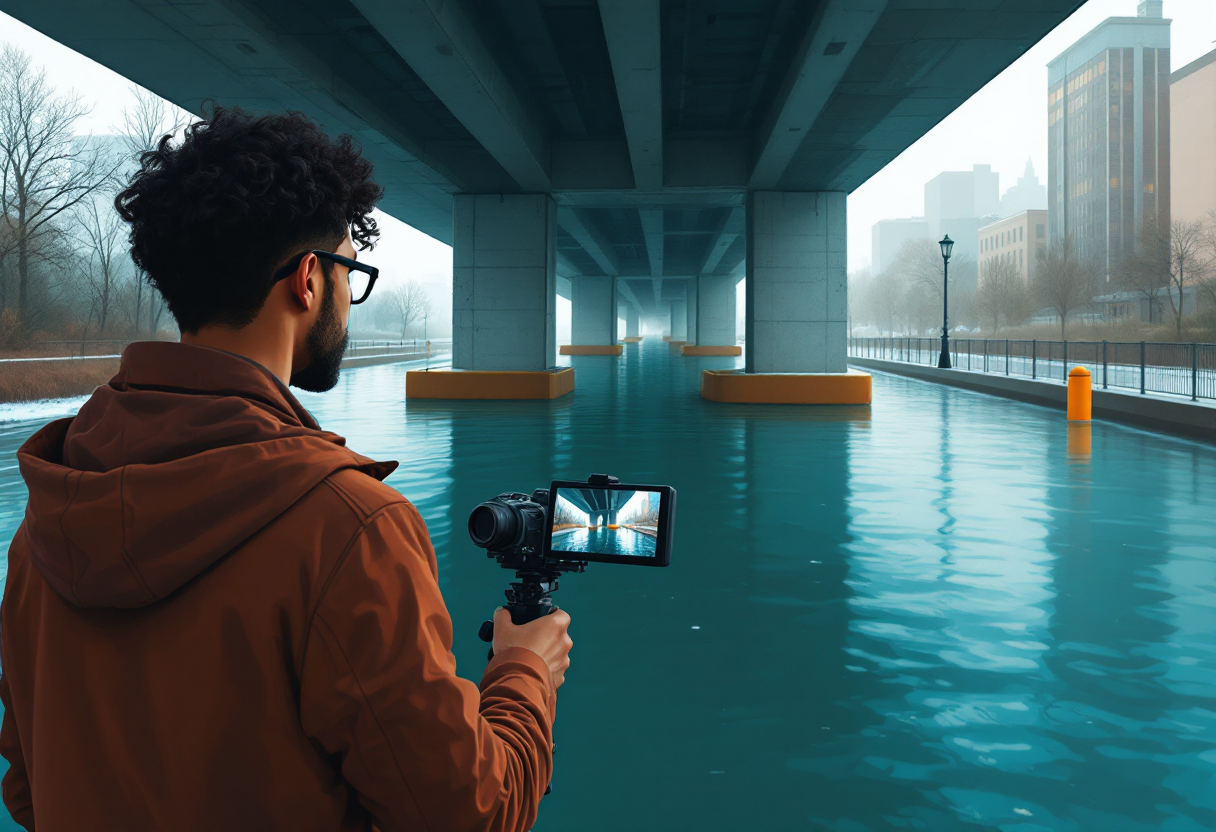
Sam is editing a short news-style video for a US audience. A repost shows water rushing through an underpass. Its caption says “Downtown today.” The clip looks convincing, but appearance cannot establish who made it, when it was recorded, or whether the caption fits.
SAM’S CASE / “DOWNTOWN TODAY” AI-generated teaching illustration · fictional case
01 Separate origin & truth02 Read origin signals03 Handle missing evidence04 Distinguish duties05 Verify before release
The job is to check two things separately: the file's history and the claim attached to it. By the end, you will distinguish origin signals, handle missing evidence, separate marking from disclosure, and run a four-step verification before publishing.
Educational, not legal advice. The EU comparison explains one framework; it does not establish the US rules that apply to your project.
01 / Break the badge reflex
Origin ≠ truth.
Here, “true” or “false” describes the accompanying factual claim, not whether pixels were generated. A marker is an origin signal, never a truth verdict. Content Credentials can accompany camera footage as well as AI-generated media.
TRUE CLAIM
FALSE CLAIM
HAS MARKER
NO MARKER
Consider four versions of Sam's underpass post. With a marker and a true claim: signed camera footage accurately captioned with its original date. With a marker and a false claim: that same signed footage reposted as “Downtown today.” Without a marker and a true claim: an unmarked copy with the correct date. Without a marker and a false claim: an unmarked copy with the misleading caption. Every combination is possible.
Even an honestly labelled AI reconstruction can support an accurate explanation when presented as a reconstruction. AI-generated does not automatically mean misinformation; camera-recorded does not automatically mean the caption is correct.
02 / Read the mechanism
Two ways to carry an origin signal.
Same scene. Different evidence.
A camera-origin record and a generator watermark answer questions about production. Neither independently checks the caption.
AI-generated teaching illustration · not evidence of an actual storm
Embedded signal
Invisible watermark
∿·∿·∿·∿·∿·∿
Media signal → compatible detector
An invisible digital watermark encodes a machine-detectable signal in the media itself. Unlike a visible logo, it is not meant to be seen by the audience. A compatible detector may recognize a supported generator or help reconnect a file to an origin record.
Some watermarks are designed to survive ordinary edits. That is resilience, not invulnerability: heavy compression, cropping, or other transformations can weaken detection. A negative result can mean no supported watermark was found; it does not establish human authorship. Sam cannot inspect the image by eye and declare it unwatermarked.
Capture → trim → export Signed history + file binding
Content Credentials are provenance records: signed statements about a file's origin and recorded changes. A verifier checks the signature, the record's connection to this file, and the signer against its trust framework. Sam should inspect who signed, what was recorded, and where the chain has gaps.
A valid signature supports integrity and attribution of the recorded statements. It does not independently verify every statement or guarantee a complete history. Even a camera can photograph a staged scene. Watermarks and credentials can work together; one is an embedded signal, the other a verifiable record.
Sam sees a valid Content Credential on the underpass clip. What can Sam conclude?
A credential does not check the caption against the world. Sam still needs date and location evidence.
Yes. Read the signer and recorded history, then verify the factual claim separately.
A valid record can still have a limited history. Inspect what is actually included.
Camera footage can also carry Content Credentials. Read the record rather than infer its contents from the badge.
03 / Evidence can get lost
What survives the repost?
Sam's downloaded repost has no readable credential. Platforms and export workflows can strip metadata; a screenshot generally loses the original file's embedded history. Cropping or compression can also weaken watermarks, depending on the method and edit. None of these losses proves deception.
Illustration · transformation simulation, not forensic processing
Evidence readout
Sam asks for the original file, preserves the received copy and source link, and continues checking. Some systems can recover external provenance using a watermark or fingerprint, but recovery is not guaranteed. Missing credentials, an invalid signature, and a valid credential with limited history are different findings; record the actual result rather than collapsing them into “fake.”
In the EU framework, a provider supplies an AI system under its own name; a deployer uses one professionally under its authority. Sam's organization may be the deployer if it uses AI to create a realistic reconstruction. Merely receiving a repost does not make Sam its AI provider.
PROVIDERMachine-readable markArticle 50(2)
→
DEPLOYERClear audience noticeArticle 50(4)
→
VIEWERInformed exposureOrigin still ≠ truth
A staged reconstruction · AI-generated teaching illustration
Article 50(2) addresses provider-side machine-readable marking of synthetic outputs. The approach is technology-neutral: watermarking, signed metadata, or another mechanism must meet applicable effectiveness, interoperability, robustness and reliability requirements as technically feasible. No named technology automatically guarantees compliance.
Article 50(4) separately addresses audience-facing disclosure of deepfakes and certain AI-generated public-interest text. An invisible provider mark does not replace a clear disclosure to viewers. Disclosure describes AI involvement; it does not verify the story.
Standard assistive editing, or edits that do not substantially change input or meaning, fall within the provider-marking exception; calling a fabricated event “an edit” does not decide the issue. For public-interest text, human review or editorial control plus an accountable editorial publisher can remove that text-disclosure duty. That text exception is not a blanket deepfake exception.
Art & authorized uses
Evidently artistic, creative, satirical or fictional deepfakes have an adapted disclosure duty that should preserve enjoyment of the work, rather than a blanket exemption. Law-enforcement exceptions depend on uses authorized by law, not on a creator simply claiming a public-interest purpose.
Illustrative reconstruction workflow
Timing & release context
Article 50 applies from 2 August 2026. Provider marking for systems placed on the market before that date has a limited transition to 2 December 2026; this is not a general delay of deployer disclosure. These are EU requirements, not a US-wide rule. Platforms also set their own rules: YouTube, for example, requires disclosure for realistic, meaningfully AI-generated or altered content. Sam checks the relevant platform and jurisdiction for the release.
02 DEC 2026Limited legacy-system provider-marking transition ends
EU comparison. Educational, not legal advice. US release decisions require the relevant US and platform rules.
Sam's team releases an evidently satirical deepfake in an EU-scoped professional project. Which statement best reflects Article 50?
The artistic/satirical provision adapts disclosure rather than eliminating it.
Machine-readable marking and clear audience disclosure serve different audiences.
Yes. Disclose appropriately without hampering the work; satire is not a blanket exemption.
The limited December transition concerns provider marking, not all deployer disclosures.
05 / Your turn at the edit desk
Run the verification.
Fictional case • local simulation • no live detection0 / 4 steps complete
Step 01
Inspect metadata
1. Inspect metadata. Preserve the received file and source link. Check available dates, software and credentials; ordinary metadata can be absent or editable. In this case, the repost has no readable credentials. This is a gap, not a verdict. Request the original.
Received: downloaded repost
Readable credentials: not found
Received copy and source link: preserved
Step 02
Reverse lookups
2. Reverse lookups. Search representative keyframes and compare earlier uploads. A matching post from a previous storm is a lead; the earliest result found is not necessarily the first publication. Sam finds an earlier matching upload and follows its source.
Earlier matching upload: found
Twin pillars and amber bollard: match
Earlier storm caption: follow the source
Step 03
Verify provenance
3. Verify provenance. Check the original in a compatible credential verifier: signature status, signer, file binding and recorded edits. The fictional original validates and records camera capture and a later trim. That supports the recorded history, not the repost's caption.
Original received · signature: valid
Signer: recognized in this simulation
File binding: passes
Recorded history: camera capture → trim
Step 04
Evaluate context
4. Evaluate context. Compare the location, date and full sequence with independent reporting and the source's account. In this case, the underpass matches, while original footage and independent storm records place the scene in an earlier storm. The “today” claim fails even though the footage is camera-recorded.
Source: footage from earlier storm
Independent storm archive: earlier date matches
Underpass landmarks: location matches
Claim “today”: contradicted
EVIDENCE NOTEBOOK
Metadata missing; original requested.
Earlier match located; source traced.
Original provenance validates; caption still unverified.
These steps organize evidence; they do not guarantee certainty or need to be performed only once. If evidence conflicts, loop back or hold publication. The teaching console simulates these records; it performs no live searches or forensic analysis.
The release decision
Publish what the evidence supports.
Sam holds the viral caption. The clip may be usable as clearly dated archival footage once sourcing, permissions and editorial checks are resolved. If the date or place remains unresolved, Sam should say what is unknown or keep investigating rather than assert “real” or “fake.”
ARCHIVAL USE CANDIDATE · verify sourcing and permissions AI-generated teaching illustration
Recap: separate origin from truth; treat missing markers as missing evidence; inspect metadata, reverse lookups, verify provenance, and evaluate context; disclose AI involvement when applicable. Preserve originals and evidence notes for the next editor.
Next: five questions. Choose one option per question; feedback appears together on Results. Pass at 4 out of 5.
Assessment
Assessment Starting
You are about to begin the assessment. Select the best answer for each question.
The underpass clip has a valid credential, but its “today” caption contradicts the source date. Which conclusion fits?
Which distinction should Sam use when checking the original file?
The uploaded copy has no readable credentials and no detected watermark. What should Sam do next?
A covered provider's system was placed on the EU market before 2 August 2026. Which timing statement is accurate?
Sam has checked metadata, found an earlier matching upload and validated the original's provenance. What best completes verification of “Downtown today”?
Final assessment
Your results.
0%
Your evidence decisions matter more than a badge. Review each answer, then return to any concept you want to practice.
Question 1 ·
The underpass clip has a valid credential, but its “today” caption contradicts the source date. Which conclusion fits?
Your pick:
Correct answer:
Question 2 ·
Which distinction should Sam use when checking the original file?
Your pick:
Correct answer:
Question 3 ·
The uploaded copy has no readable credentials and no detected watermark. What should Sam do next?
Your pick:
Correct answer:
Question 4 ·
A covered provider's system was placed on the EU market before 2 August 2026. Which timing statement is accurate?
Your pick:
Correct answer:
Question 5 ·
Sam has checked metadata, found an earlier matching upload and validated the original's provenance. What best completes verification of “Downtown today”?
Your pick:
Correct answer:
Certificate of completion
Can We Trust What We See?
Your name
Completed the creator verification lesson with a score of at least 80%.
Educational learning record only; not a legal or forensic qualification.